Email Marketing
Email Marketing is a digital marketing strategy that uses email to communicate with potential and existing customers. Businesses use email to build relationships, promote products and services, generate leads, increase sales, share valuable content, and retain customers.
Unlike social media, email allows businesses to communicate directly with people who have chosen to receive their messages.
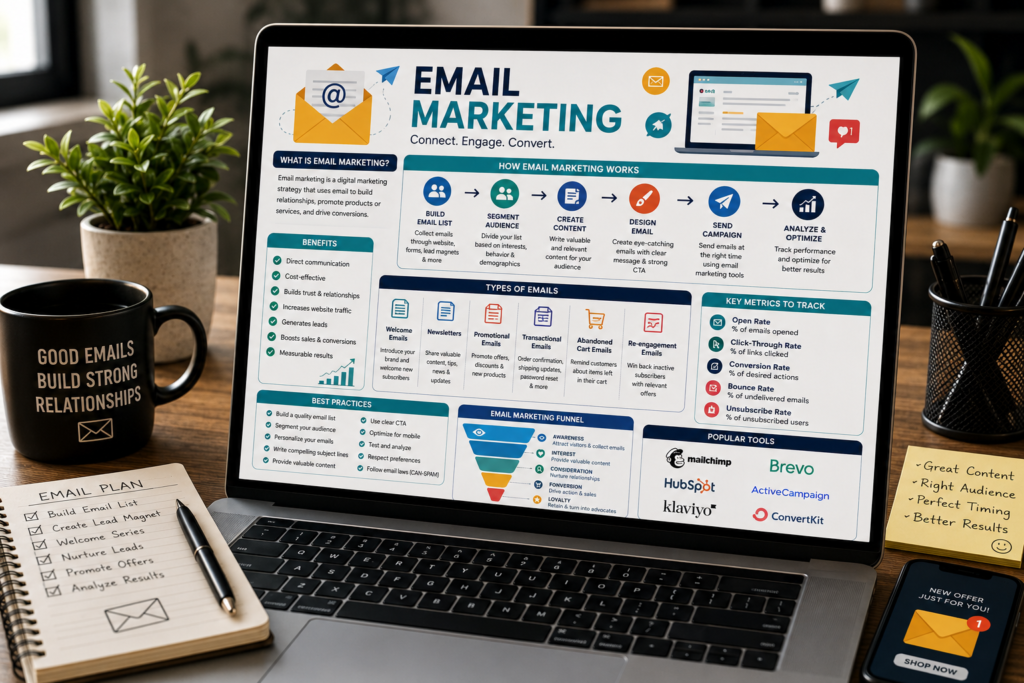
Why Is Email Marketing Important?
Email marketing can help businesses:
- Build direct customer relationships
- Generate and nurture leads
- Increase website traffic
- Promote products and services
- Increase sales and conversions
- Build customer loyalty
- Share company updates
- Promote special offers
- Recover abandoned purchases
- Personalize communication
- Measure campaign performance
Types of Email Marketing
1. Welcome Emails
Sent when someone subscribes, registers, or becomes a new customer.
They can include:
- Welcome message
- Introduction to the brand
- Benefits of subscribing
- Important resources
- Special offers
2. Promotional Emails
Used to promote products, services, discounts, and special offers.
Examples:
- Seasonal offers
- Festival discounts
- New product promotions
- Limited-time deals
- Special coupons
3. Newsletter Emails
Newsletters are regularly scheduled emails containing useful information.
They may include:
- Blog articles
- Industry updates
- Tips
- Company news
- Educational content
- Product updates
4. Product Update Emails
Businesses can inform customers about:
- New products
- New features
- Product improvements
- New services
- Important announcements
5. Lead Nurturing Emails
Not every lead is ready to buy immediately.
A lead-nurturing sequence provides useful information over time to build trust and move potential customers closer to a purchase.
Example:
Educational email → Helpful guide → Case study → Service information → Offer → Conversion
6. Abandoned Cart Emails
For e-commerce businesses, these emails remind customers who added products to their cart but did not complete the purchase.
A sequence might include:
Cart reminder → Product benefits → Customer reviews → Incentive
7. Transactional Emails
These are triggered by specific customer actions.
Examples:
- Order confirmation
- Payment confirmation
- Shipping updates
- Password reset
- Account verification
- Booking confirmation
8. Re-engagement Emails
These emails target subscribers who have stopped opening or interacting with emails.
The goal is to encourage them to become active again.
9. Customer Retention Emails
Businesses can stay connected with existing customers through:
- Helpful tips
- Product recommendations
- Loyalty rewards
- Personalized offers
- Follow-up messages